Showing posts with label Mobile. Show all posts

AT&T : Connect all your devices with one number


As you buy more devices and wearables, the idea of having one phone number to connect them all is an increasingly attractive one.

AT&T is readying a service that will allow users to connect all their devices, from smartphones to wearables, with a single phone number.

The company promises that the service, called NumberSync, will allow users to send and receive texts and calls from any device using one number. A person familiar with the matter confirmed to Mashable that the service will be made possible due to changes on AT&T's existing telecom network. And unlike some similar Bluetooth-based solutions, NumberSync connectivity will function even if the user's primary mobile device with the originating number is physically nowhere near the other NumberSync-connected devices.

"Since NumberSync operates in our wireless network, it is not dependent on a Bluetooth connection to your smartphone," AT&T spokesperson David Christopher posted on the company's website on Wednesday. "Your devices don’t need to be near each other and NumberSync will work even if your primary phone is turned off or disconnected from the network.

Christopher also mentions that the service will be able to connect wearables like fitness bands and hints at possible in-car functionality. Yet no specific NumberSync devices are mentioned, and it's not clear whether the service will work across a wide array of mobile platforms such as iOS, Android and Windows Phone.

Apple offers a similar concept in the form of its Continuity feature, which allows you to make and receive calls through your Mac and iPad via your iPhone. But depending on how AT&T's service is delivered, NumberSync has the potential be much more powerful than Apple's solution.

AT&T says the first NumberSync-ready device (likely a wearable) will launch sometime this month, with at least two additional devices to come during the holiday season.

Amazon Pilots Visual, Mobile-Only Affiliate Product To Rival Skimlinks and VigLink


Amazon is testing a new service that could help it and its publishing partners drive more traffic (and, importantly, purchases) from customers on mobile devices. The pilot software is called ‘Mobile Popover’, and it is a mobile-only rival to top affiliate services Skimlinks and VigLink.

The service detects text links on a webpage to automatically surface an image-centric link — which includes details of price, description, ratings and shipping information — and tempt readers into purchasing the item. Clicking the banner takes a user to the mobile web version of Amazon’s store, from there they can open the page in the Amazon app if they have it installed on their device.


In the event that an item is purchased, the publisher is rewarded with a cut of the purchase. We don’t yet have details of the commission percentage for Mobile Popover, although it is likely to be in line with Amazon’s existing affiliate program, which pays out between one and 10 percent of each purchase depending on the type of item bought.

The integration itself is a simple Javascript additional that works for all pages. Amazon is trialling Mobile Popover with a limited group of initial partners at this point, but it looks like other partners can get involved via this link.

Mobile is a huge opportunity for online retailers, particularly when you look at Alibaba and businesses in China which did over 60 percent of their business from mobile devices on China’s largest e-commerce day.

For its part, Amazon recently revealed that “approaching” 60 percent of its Christmas 2014 holiday transactions came from mobile, but it is yet to fully transition its hugely successful business to small screens.

Indeed, last week it pulled its consumer-facing wallet app after less than a year in the market. A spokesperson told us that Amazon had “learned a great deal” from the project, but it’s fair to say it hadn’t gone as well as the company will have hoped.

Skimlinks and Viglink had a run-in with Amazon in Europe last August, when the U.S. giant stopped paying out affiliate money made from auto-tagging from webpages. Amazon’s own affiliate program includes text links, mobile banners, responsive banners and widgets — there’s also an option to integrate with third-party blogging platforms.

London-based Skimlinks was founded in 2006 and has raised over $9 million in funding to date. A newer entry to the market, four-year-old VigLink is based in San Francesco. It has raised over $27 million, including an $18 million Series C led by RRE Ventures that closed last summer.

App For Low-End Android Phones By Facebook


Not content with spinning out apps for stickers inside Messenger, Groups and new addition Rooms, Facebook has launched another standalone app. Facebook Lite, which some may recall as a simplified version of its mobile website from 2009-2010, is specifically designed for low-end Android devices in emerging markets.

TechCrunch understands that the app was quietly launched in a handful of countries in Asia and Africa over the weekend — Bangladesh, Nepal, Nigeria, South Africa, Sudan, Sri Lanka, Vietnam and Zimbabwe to be precise — where it is being testing with a view to further expansions. That said, a wider launch is not a certainty and Facebook could quietly can the project if it doesn’t believe it is worth pursuing.

The app has been built to accommodate low-end and dated Android devices, and users who are on 2G/poor quality internet connections. It’s based on Snaptu, Facebook’s feature phone client, but includes some native Android features, such as push notifications and camera integration, to make the experience a more sophisticated one.


Why is Facebook launching yet another app? Smartphone sales are soaring in India, which was the fastest growing market in Asia Pacific in Q3 2014, while there’s huge potential in Africa and Southeast Asia where mobile will be (or already is) the primary internet platform for millions. Even though Facebook retooled its Android app specifically for emerging markets last year, it is making sure that it offers a good experience to any user not matter their device or network connection. (Android is the platform of choice for most smartphone owners in emerging markets since devices can cost upwards of $30.)

Facebook already has its Internet.org project, which provides free access to a range of mobile internet services including, of course, Facebook. Internet.org is currently limited to a selection of countries in Africa at this point and, since it is being developed in partnership with carriers and other telecom industry players, launches are time and resource intensive: so why not pull together a ‘Lite’ app that can potentially be pushed to millions overnight, that’s Facebook’s thinking here.

If you’re in one of the aforementioned eight countries where Facebook Lite has launched — and you have an Android phone — then you can check it out here.

The early signs seem positive. The app has already crossed 10,000 downloads at the time of writing, with a 4.6 rating from an initial 693 reviewers. The few early users tweeting about it seem impressed too.

"Apple Pay" Could Launch This Week.


Apple Pay could launch as soon as this week, a report suggests.

The company is in the midst of prepping staff at its Apple retail stores for the upcoming rollout of Apple Pay, according to 9to5Mac. The mobile payment platform will allow users to complete transactions by tapping an iPhone at a payment terminal and authenticating your fingerprint.

Employees at Apple retail stores are required to attend a one-hour Apple training session in the coming days, the report says. It's a sign that Apple is close to launching the service in stores.

It's also been reported that a memo to Walgreens managers points to a launch date as soon as Oct. 18. Apple will hold a media event on Thursday, and it's possible that the company will officially launch the service or give more details about its launch date.

9to5Mac reports that it got its hands on some training materials and setup screenshots revealing more details about Apple Pay's interface and transaction functions.

Apple Pay will be activated through the iOS 8 setup process or a new settings tab called Passbook and Apple Pay, the report said. Credit card information will also be added by using your iTunes account or scanning your card with the iPhone's camera (it can hold up to eight cards at a time).

The Apple Pay display shows a list of recent transactions, card numbers and other details related to your account. Users get push notifications when credit cards expire too.

If Apple Pay isn't working properly, employees can access an “Apple Pay Demo” that can pinpoint the problem, the report said. All Apple retail employees — not just Genius Bar staffers — are said to be familiar with the new demo.

Have something to add to this story? Share it in the comments.

BONUS: 5 Things You Don't Know About Your iPhone


Samsung's tiny 1TB SSD is blazing fast, but so pricey


Storage is not sexy tech. With the exception of LaCie’s fancy (and pricey) designer hard drives that double as living room decor, storage is not tech that needs to look good. What it needs to do is reliably store your data and transfer files as fast as possible.

Samsung’s Portable SSD (solid state drive) T1 ticks both the security and speed checkboxes, and does so in high style without going overboard.

The T1 measures 2.1 x 2.8 x 0.36 inches — smaller than a standard business card — and weighs a featherlight 0.9 of an ounce. It's so light that it feels like there’s nothing inside its plastic casing, let alone 1 terabyte (TB) of storage.

Samsung says you can slide it into a wallet. It fits in my normal-sized leather bi-fold, but it just won't close. So not really. It'll fit in a clutch, small purse or pocket fine, though.

In the age of potential hacking, security is everything. The T1 includes AES 256-bit hardware encryption — real NSA-level protection. Locking up your data is as easy as installing a special driver and then creating a password. Be smart: Don't use "123456" or "password."

In addition to being safe from digital snooping, the T1 is also safe — physically. Unlike hard drives, which have platter disks and moving mechanical parts, the T1 has none. Its SSD nature means it can be thrown around like a hot potato and the stored data will be safe at all times.


Fast transfers

Waiting for big files to transfer is as exciting as watching paint dry. Depending on your drive and cable interface (USB 2.0, USB 3.0, Thunderbolt, etc.), your transfer speeds will vary.

The T1 boasts read and write speeds of 450 megabytes per second (MB/s) when connected through USB 3.0, which itself supports transfer speeds of 5Gb/s. In practical terms, Samsung says you can transfer a 3GB movie in eight seconds. I didn’t have a 3GB movie file, so I grabbed a bunch of mixed file types totaling 3GB and put the T1 to the speed test.

Sure enough, a 3.1GB folder transferred from my 2012 MacBook Air to the T1 in about 7.74 seconds (average of three tests). Copying the same 3.1GB folder from the T1 to the Air took about 14.23 second (average of three tests).


Samsung Portable SSD T1

How does that compare to a typical USB 3.0 portable hard drive? My 1TB Western Digital My Passport Slim, a popular drive which sells for about $70, was left eating the T1’s dust. It took about 35.8 seconds to transfer 3GB from the laptop — five times slower than on the T1. Transfers from the hard drive to the laptop took about 31.71 seconds, or about twice as slow.

A 15.1GB 4K-resolution video transferred from my Air to the T1 in 37 seconds. It took nearly 3 minutes with the regular hard drive.

Samsung’s T1 speed claim isn’t just hype, or a best-case-scenario theoretical number. It's really frickin' fast — perfect for people who work with really big files who need to transfer them often. Roving video editors will really like this thing.


Mainly for professionals

Hard drives are cheaper than they've ever been before. You can easily get a portable 1TB hard drive for well under $100. Solid-state drives, while coming down in price over the last couple of years, still command a premium.

The T1 commands a premium and then some: $179 (250GB), $299 (500GB) and $599 (1TB). But damn it if the T1 isn’t badass for such a tiny little guy.

At those tiers, the T1 is a luxury product for anyone who isn't a photographer, videographer or creative professional who can really make use of its high-speed performance while on the go. For them, time is money. Regular people will be just fine with normal "cheap" portable hard drives. They still work great; they're just not as small, and not as fast.


Samsung Portable SSD T1

The Good

Tiny and light • Blazing fast transfers • NSA-level encryption


The Bad

Expensive • Must install security driver to use on computers


The Bottom Line

If you can afford it, the Samsung T1 is an awesomely stylish and tiny way to carry lots of files in your pocket. It's also crazy fast and secure.


Have something to add to this story? Share it in the comments.

HTC's first smartwatch and M9 smartphone coming soon


HTC is close to unveiling its first wearable, according to a new report.

The Taiwanese company is expected to show off its first smartwatch and its next flagship smartphone, the M9, at the upcoming Mobile World Congress in March, Bloomberg reports.

Citing "a person familiar with the matter," the report says the M9 — the successor to last year's HTC One M8 — will be equipped with a 20 MP rear-facing camera, Qualcomm's eight-core Snapdragon 810 processor and an improved UltraPixel front-facing camera.

It's also expected to use the latest version HTC's Sense user interface, Sense 7, and its speakers will use Dolby's latest audio technology.

The report didn't elaborate on many details about the long-awaited wearable, but the watch will reportedly come with Under Armour's new fitness software baked-in the watch will reportedly come with Under Armour's new fitness software baked-in. The two companies announced a new partnership earlier this month centered around the company's new Record app.

Record pulls in stats from a variety of fitness-tracking wearables, including Under Armour's, with the goal of creating a platform that allows users to interact and share their progress even if they are using different activity tracking devices.

HTC was originally expected to launch its first smartwatch in 2014, but that release was delayed after executives said the wearable simply wasn't ready yet.

Pricing and availability details for the two devices are not yet clear. The company has struggled to compete with companies like Samsung and Apple, despite well-reviewed devices. HTC reported its first profitable quarter — after three consecutive quarters of loss — last year.

Have something to add to this story? Share it in the comments.

An(other) App For Quantifying Phone Usage By "QualityTime".


Running out of stuff to quantify? Never fear! A new app launching today on Android promises to quantify your device use — by serving up a usage timeline right to your lockscreen so you can be horrified at how many times you’ve unlock your phone today, or by the amount of life-minutes you’ve squandered on Facebook.

ZeroDesktop, the startup behind the QualityTime app, has previously made an app for parents to manage their kids’ device usage, called DinnerTime, as well as crowdfunding an Android computer for families called the MiiPC.

President and co-founder, Richard Sah, says the team sees two main markets for QualityTime: people who are worried about over-using their devices, and also those who are just curious, and want to track their app usage.

The team’s earlier kids-focused app apparently sparked the idea for QualityTime — after they got feedback from adults asking for something similar to “self help” themselves. And presumably to contribute to domestic harmony.


“We found that there were adults using [DinnerTime] (i.e. partners using it on each other, friends using it on each other).We know that adults can also experience excessive app usage addiction — but observing parents and friends using it to help each other really raised our interest in this area.”

QualityTime lets users set custom usage alerts to help manage how long they spend on their device and/or particular apps. It can even be set up to lock the screen for set periods of time. Which might help nix arguments between couples about device usage at bedtime, for example.

The app will also integrate with IFTTT — functionality that’s coming later this month. So, for instance, excessive Facebooking could be set up to turn your Philips Hue lightbulbs deep blue. Or more than 500 unlocks in a day could result in an auto dial to your significant other for a pre-agreed ear-bashing. Or add a shame note to your Google Calendar.

Whether over reliance on tech is best managed by reliance on more tech to provide background warnings/notifications is up for debate. But at this point in the digital evolution strata it’s apps all the way down.

Indeed, QualityTime itself follows in the phone-usage quantifying footsteps of BreakFree, Checky, Moment to name three similar services. That’s presumably a sign of something. Growing concern about app addiction is one possibility. Nothing new under the app sun, with major app stores having passed the one million apps mark, is another. And/or the speed with which a digital idea can proliferate and be cloned or tweaked is yet a third.

“There is a big appetite for this kind of product, as mobile/app addiction is such a widespread problem,” says Sah. “The difference [between QualityTime and rival apps] is that ZeroDesktop is leveraging its cloud-based solution expertise to create a family of products in this arena.

“We’ve accumulated data based on user feedback following the launch of the DinnerTime Plus app, and used this to build on the app development for QualityTime, ensuring that the user experience is the priority. ZeroDesktop want to provide not just a single app, but holistic solutions – a family of products and tools for various ages.”

For a little general context on app usage, a recent year-end report from app analytics firm Flurry found overall app usage grew by 76% in 2014. Top app categories included Shopping, Utilities & Productivity, and Messaging — which all recorded triple-digit growth in the past year.

The QualityTime Android app is free to use, and saves usage data for up to two weeks. A premium version will be coming down the line — enabling users who are willing to shell out some money for the utility to geek out over their usage data for six months.

An iOS version of QualityTime is also planned — although, given Apple’s control over its ecosystem — it’s clearly not going to be able to take over the lock screen or freeze device usage. So expect some kind of app analytics dashboard that can send you a few custom notifications.

Extremely thin smartphone 'Galaxy A7' launched Samsung


Samsung announced Monday the launch of the Galaxy A7, one of the company's slimmest smartphones ever.

The very Galaxy Alpha-like device has a metal frame and a body, which is only 6.3mm (0.245 inches) thick. With Samsung's head of IT & Mobile JK Shin describing the device as "stylish," it's obvious that Samsung is going for looks first and performance second.

Still, the Galaxy A7 has a decent set of specifications, with a 5.5-inch AMOLED screen, a 1.8GHz quad.core processor, 2GB of RAM, 16GB of memory (extendable up to 64GB via a microSD memory card) and a 13-megapixel shooter on the back.

Other features of note include a 2,600mAh battery, LTE support and Android 4.4 KitKat. Interestingly, Samsung's specifications list the screen as HD, but the company never specifies whether it means full HD (1920x1080 pixels) or HD ready (1280x720 pixels).

The device will also be available as a dual-SIM variant, but with a slightly slower, 1.5GHz quad-core main processor.


The phone is a continuation of Samsung's Galaxy A line of products, with A3 and A5 being launched in Nov. 2014. Those two devices were also exceptionally slim — at 6.9mm (0.271 inches) and 6.7mm (0.264 inches), respectively — but not as much as the A7. For comparison, the company's flagship smartphone, the Galaxy S5, has a body that's 8.1mm (0.319 inches) thick.

The Galaxy A7 will be available in three colors — Pearl White, Midnight Black, and Champagne Gold — in select markets, though Samsung did not disclose the date or price.

Have something to add to this story? Share it in the comments.

Keyboards Into Wearable Devices


The year is 1989 and our esteemed hero, Marty McFly, has just touched down in a fictional Hill Valley of 2015 to save his kids from his childhood nemesis. Back in the ’80s, when the Back to the Future franchise first took the world by storm, the incredible technologies presented there seemed more of a pipe dream fantasy than prophetic sci-fi.
Fast forward to the real 2014. While the Back to the Future crew did get some things right, they definitely missed the mark on the technology that has the whole (tech) world obsessed — wearables.
As wearable technology slowly matures beyond fitness and health to tackle business and personal use, the challenge of inputting language into a wearable is quickly coming to the forefront of the discussion. While the oh-so-popular QWERTY keyboard has doggedly survived the communication revolution, the obvious spatial constraints presented by a smartwatch or smart glasses present some serious obstacles.
As is often the case with developers, there are already a number of different schools of thought regarding the best approach for text input in wearables. While some are already implemented, others are still in their infancy.
The Traditionalists aka QWERTYphiles
While some of the Traditionalists head toward touch keyboards, others are heading to virtual ones. No matter the implementation, with Traditionalists there is no compromise regarding the layout — it’s QWERTY for life in this club.  Today, you can find several examples of these types of keyboards, from clothes with a built-in wireless keyboard; a small-scale minimized keyboard such as Minuum’s that you can enlarge or minimize to access different keys, and even a glove that is used as a wearable keyboard for QWERTY-based input.
The Augurs aka Predictivephiles
The challenges associated with displaying even a micro QWERTY keyboard on a wearable served as the inspiration for the evolution of the Augur school of thought. Advanced, adaptive text prediction software is already readily available in most smartphone keyboards, making its implementation in wearables an enticing option. Text prediction software analyzes text as it’s inputted, to identify (and present the user with) the word most likely to follow the one that’s being written. Adaptive features enable most text prediction software to learn users’ writing styles with time, so that names and styles are implemented into the engine and then offered as predictive text. This enables wearable developers to offer smaller keyboards with fewer keys, as the software should pick up on the word (and next word) being written after only a few letters.
Other predictive implementations include a doodling keyboard such as Inkboard that allows the user to tap or draw sketches on the devices digital screen and share her creations with her friends. There are even reports of an emoji-only keyboard that enables people to convey their feelings without actually having to describe them with words.
The Dictators aka VPAphiles
The final school of thought touts voice-based input as the most effective form of interacting with wearable devices. Intelligent, virtual personal assistants (VPAs) leverage voice recognition technology to dictate text to their device. The text then becomes “actionable” when relevant intentions are extracted by the software, enabling this feature to send messages, schedule meetings, place phone calls, and perform many other tasks just by speaking.
Nuance is already well ahead of the game in this field, partnering with companies like Samsung and Omate for the companies’ wearables. Demoes have shown that activities like sending emails, texts, and updating calendars with events can be done on a PA-enabled smartwatch in less than half the time it would take to perform the same function by tapping on a tiny screen.
Although many believe that Apple’s Siri fell short of expectations, the new Google Now VPA has definitely raised the bar. Google Now doesn’t just fetch information on command but attempts to anticipate the user’s needs by retrieving information even before it has been requested.
While seemingly the optimal solutions for wearables, VPAs have already been around for quite some time without denting the popularity of texting. Another interesting facet to consider is that some people might feel uncomfortable vocalizing what was once an inherently private interaction.
It seems that typing on a traditional keyboard as a means of communication is not necessarily what our future holds. Instead wearable devices will be operated by an amalgamation of all of the options discussed — voice recognition, sentence/word based predictive software and perhaps even some sort of mutated QWERTY layout.
Just take a minute and look around the next time you’re waiting for your train or bus; people are hunched over their electronic devices like zombies. Perhaps Spike Jonze’s vision of the future in the sci-fi movie ‘Her’ wasn’t that far-fetched? He portrayed our future as one where people no longer communicate with each other but rather prefer connecting to their operating system. We can’t blame them, what with wearables being available 24/7 for every possible need and being capable of listening to and understanding our problems, they probably know us better than anyone else.

Xiaomi Announces An Improved Version Of Smartphone "Redmi 2".


Xiaomi announced today that it sold over 60 million smartphones in 2014 but the Chinese company didn’t stop there after it unveiled its newest entry-level phone: the Redmi 2.

The company’s flagship Mi devices may attract all the attention, but the sub-$150 Redmi family is its biggest seller. Back in July of last year, Xiaomi revealed it had sold 18 million Redmi (/Hongmi as it is known in China) phones and 3.56 million Redmi Note phablets. The Redmi alone accounted for one-third of total sales at the time.

The Redmi 2 keeps much of the original model’s ingredients. It has the same 4.7-inch, 1280 x 720 display, but under the hood there’s an upgraded Qualcomm 410 quad-core processor. The device sports an 8-megapixel rear camera, improved 2-megapixel front camera, 1GB RAM and 8GB on-device storage. There is now dual 4G SIM support too.

The Redmi 2 — which runs Xiaomi’s own MIUI version of Android — also gives a few more options for color-loving customers. ‘Lime green’ and ‘powder yellow’ are the new additions to the palette.

The phone will cost 699 CNY, which is around $112, when it goes on sale on January 9. There’s no word on when it will be released outside of China, but you can be sure that the Redmi 2 will make its way to India, Indonesia and Xiaomi’s other overseas markets soon.

The Redmi and Redmi Note were a big focus for Xiaomi in India, where it clocked one million sales in its first five months. Indeed, the Redmi family has particular potential in price sensitive markets where most consumers can’t afford top of the range phones since it out-guns most other products in the sub-$150 price bracket.

Samsung Galaxy Note 4 is getting a speedy Snapdragon 810 processor


Samsung's flagship phone is getting an upgrade.

The company revealed a new version of the Galaxy Note 4 is coming in 2015 — one that promises better performance via an amped-up processor.

The phone will now include Qualcomm's Snapdragon 810 processor, which is the successor to the 805. Snapdragon chips power most smartphones that aren't made by Apple. The Galaxy 4 will be the first mobile device to feature the new processor.

Oddly enough, the Snapdragon 810 isn't called out by name in Samsung's news release, but it will be included in the phone, according to reports.

The new chip will give the phablet enough performance capability that you should be able to wirelessly stream 4K video or play games like you would on a console. You can even — if you're so inclined — use it as a home PC.

The phone will also boast faster LTE speeds, according to Samsung. It will run 4G LTE-A, which can be up to four times faster than regular LTE.

In our review of the phone, Mashable deemed the Note 4 the best Android phone on the market.

Most observers expect the souped-up Samsung Galaxy Note 4 will debut in South Korea — but it's still unclear how fast it will branch out to other markets around the world.

Apple Sued For Making The iOS 8 Update Too Big


Remember the collective Internet freakout over the massive iOS 8 download?

Well, now that freakout has taken the form of a lawsuit. Specifically, a class action suit filed in the United States District Court in San Francisco Tuesday, which claims Apple misled users about the size of the iOS 8 update. Two individuals are named in the suit, both from Miami.

The suit focuses on users with 8 GB and 16 GB devices, who are most affected by the unwieldy iOS 8 download since they lose a significant portion of their storage capacity when they upgrade, according to the suit.

"iOS 8 uses an unexpectedly large percentage of the storage capacity on 8 GB and 16 GB iPhones, iPads and iPods," the lawsuit alleges. Apple, it says, "fails to disclose to consumers that as much as 23.1% of the advertised storage capacity of the Devices will be consumed by iOS 8 and unavailable for consumers when consumers purchase Devices that have iOS 8 installed."

As a result, one of the plaintiffs in the suit "upgraded to iOS 8 with the belief that the upgrade would not substantially inhibit his available storage capacity."

The iOS 8 download requires almost 6 GB of storage, which left many users struggling to delete enough photos, apps, music and other files from their devices to make room. This caused significant complaints on Twitter from users who felt they were forced to wipe significant amounts of photos and other files to make room for the update.

In fact, as we outlined here, there is a way to download the iOS 8 that doesn't require deleting all your data.

Whether the suit will hold up in court remains to be seen. As Siliconbeat notes, Apple has successfully defended itself from similar suits over storage capacity in the past.

You can read the full text of the lawsuit below:

Nike Re-Releasing Shoe That Looks Like An iPhone Case


The hole-riddled iPhone 5C case that generated so much attention last year will be reincarnated in the form of a Nike shoe by none other than Apple designer Marc Newson.

Similarities between Nike's Zvezdochka, which first debuted in 2004, and Apple's iPhone 5C case are unmistakable. However, the two products are not officially related.

Named after the Russian dog that was launched into space aboard Sputnik 10 back in the 1960s, the Zvezdochka was originally designed by Newson as a modular shoe (consisting of four parts) that was inspired by the Russian Space Agency and his vision for "a multi-purpose shoe for cosmonauts."

In light of Newson's recent decision to join Apple's design team, working alongside friend and company design chief Jony Ive, the resemblance between the Zvezdochka and the iPhone 5C case is even more striking. However, Nike's site does not mention the apparent similarities.


Despite the fact that the original Zvezdochka predates the iPhone 5C case by almost a decade (and the first Apple iPhone by three years), its futuristic design proves just how far ahead of its time the shoe really was.

To celebrate the Zvezdochka's 10th anniversary, Nike is re-releasing the shoe as a limited-edition product beginning Dec. 29, through its NikeLab website.

Twitter Analytics Now Available On iPhone App


Twitter analytics are now available on the iPhone app.

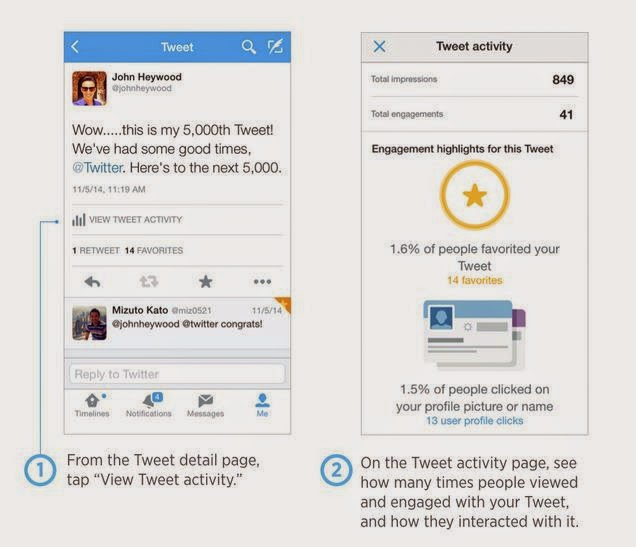
Analytics show users how many impressions their tweets get and charts other engagement metrics, as well as retweets and favorites. So even if a tweet isn't getting retweeted 1,000 times, users can see if people are still interacting with the post.

The new feature launched for iPhone on Monday. To access mobile tweet analytics on an iPhone, users can click on one of their tweets, then tap the "View Tweet activity" beneath the post. After that, the analytics page appears to offer everything that's available on the desktop version. Here's how it looks on the iPhone:


Analytics are only available if you have the most recent version of the Twitter app, and they're only on iPhone (for now, anyway). It's unclear if Twitter is planning to expand the feature to its iPad, Android or Windows apps. Twitter didn't immediately respond to Mashable's request for clarification.

Originally designed for advertisers, Twitter rolled out its analytics interface to marketers, verified users and Twitter Card publishers earlier in the summer. In August, Twitter made analytics available for all users.

13 Free iPhone 6 wallpapers Must In Your Pocket


Treating yourself to a new iPhone 6 this holiday season? Time to customize it.

Creative wallpapers for your home and lock screens are a great personal touch for any phone. Don't just stick with the pre-selected, built-in wallpapers — branch out.

To help you narrow down your search, we rounded up some stunning photos converted to fit an iPhone 6 screen. Here are 13 gorgeous wallpaper designs you can use for your new phone.
 
1. Swirling skies


2. Overhead city

 
3. Fall feeling


4. City at sunset


5. Towering skyscrapers 


6. Winter trees


7. Aerial landscapes

 
8. Overgrown


9. Neon streets


10. Sunrise


11. Campfire


12. Christmas music


13. Bubbly view


Latest Firefox Phone Has Transparent Shell


A new phone that runs Firefox OS is launching in Japan on Christmas Day, and it's a looker.

The Fx0 phone has an unusual feature that makes it stand out next to iPhones and Android devices: The Fx0's exterior casing is transparent.

The see-through phone is the product of a partnership between Mozilla and Japanese telecom giant KDDI. It's the first Firefox OS phone to include features now commonplace among smartphones, such as 4G LTE and NFC (near-field communication), the technology used for mobile payment transactions.

In terms of specs, the phone isn't exactly remarkable, though it is a big step up from most Firefox OS phones. It has a 4.7-inch display, the same size as the iPhone 6, and also carries a 1.2 GHz quad-core processor and a relatively modest 2,370 mAh battery.

The phone was designed by Tokujin Yoshioka — who seems to have a thing for transparent phones. His brief was to embody the "openness, freedom and transparency" that Mozilla apparently wants to exhibit, according to a Mozilla blog post.

The Fx0 retails for 50,000 yen (about $420), which is a step up from Mozilla's $33 smartphone made for the developing world.

There are 16 phones that run Firefox OS, and they're available in 29 countries. No word on when or whether U.S. consumers will ever be able to get their hands on the Fx0.

INFLUENTIAL BLOGGING TOOLS FOR ANDROID SMARTPHONES


Advent of smartphones has made many spheres of life easy. From online shopping, to banking, handling daily chores all can be done from a touch on your cell phone screen. Supporting fast internet speed, modern browsers, high definition cameras and robust apps smartphones has changed the blogging business revolutionary. Now bloggers don’t have to sit in front of their PCs or laptops and make posts or uploads images. All this can be done from their smartphone.  Indeed advanced blogging functions, writing posts to uploading images and videos all can be done even when a blogger is travelling.

Being an ardent Android Fan I will share of the high quality Android apps that are must for every blogger.


Mange Your Blogging


WordPress App: This app allows you to manage all your wordpress blogs from your phone. It provides all those wordpress tools which are available in its online version. From creating new posts to managing all the comments you received on your posts, to uploading multimedia files on your blog all can be done through this app. You can also analyze your blog visitor’s statistics from it. And it is a FREE app.  

Text Editors

QuickOffice App: Many bloggers prefer to first write their post in word and then paste it to the html editor of their blog. Then this app is for you. In this paid App ($14.99) you can connect with your dropbox, Google Docs and other online document sharing site accounts. 

Writer App: If you like to write your posts in plain text editors than instead of paid word docs, you can use this FREE writer app which provides you with simple, free plain text editor. 

DroidEdit Pro App: This one is my favorite. This app provides you with best of the environment for writing and editing your HTML posts. Bloggers liking hi-fi features will love this app because of its syntax-based color-coding, keyboard shortcuts, HTML previews, and connections to Dropbox features. But for all this one has to pay the price of ($1.69) which is worth spending.

Image Editing

FX  Photo Editor App:  This paid ($3.99) android app can make image editing an easy task for bloggers using android smartphones. In this app you will find options for image editing like resize, rotate, crop and many more complex process.

Photoshop Touch App: This one is perfect for android tablets. Taking flexibility of your bigger screen you can add layers to your images with this app for which you have to pay $9.99.

Analytics and Social Media


gAnalytics App: This free app gives you the mobile version of your Google Analytics. With this you can manage all your analytics accounts from your smartphone.  

Hootsuite App: Sharing a blogpost in social media is good for blogging. So to continue that from your android phone Hootsuite is a good option. Professional bloggers can add their social media profiles for Facebook, LinkedIn and twitter at one place and can manage all from social media management dashboard of the FREE app. 

File Management


Explorer + File Manager Pro App: After paying $3.99 for this app one can directly access all their files from their android phone.

FTP Café App: If you want to manage your ftp from your phone this app is apt for that. At the cost of $3.99 FTP Café offers you all the functions which an FTP can do from file upload to download.

Notes and Reading

gReader Pro App: Pay $5.99 and get this gReader Pro App in your android phone which wil let you e-read through your favorite blogs.

Evernote App: This is a FREE cloud-based notes App in which you can make endless notes.


Author Bio: Catherine Jones writes for residential voip home phone service. She is a freelance blogger and likes to write about various topics like social media, latest technology trends.

CYBER SHAFT MOBILE

       
Mobile version of Cyber Shaft has been been released and now all our user can view our blog on there mobile also.

You can also scan the QR-Code which has been provided below and connect with Cyber Shaft.


TRACING MOBILE NUMBER


Hello everyone my this article will you how can we trace a mobile number. Tracing a mobile number does'nt means that you will know eact location of the mobile or sumthng like that. By online tracing what all information you can gather is that the operator of sim card and the state of which that sim card belongs to and also the region .


Tracing mobile location to its exact position is not an easy task you need authorizations from mobile companies and othe confirmation. If you want trace any mobile to its exact location then you need many resources some of your linkups with network towers and also with mibile companies to gain access to mobile.


You can protect your mobile from geting stolen and you can trace your mobile if it gets lost bye using a very simple and free software which gets installed in your mobile and when ever you change the sim card an automatic response from that software is send to n other mobile which you have set before hand.The number of the new sim card and the exact latitude and longitude are recived. by using these information you can trace back your mobile and get it ............